classSolution { public: string freqAlphabets(string s){ string res = ""; for(int i = 0; i < s.length(); ) { char c = s[i]; if(i+2 < s.length() && s[i+2] == '#') { char cc = s[i+1]; int temp = (c - '0') * 10 + (cc - '0') - 1; res += ('a' + temp); i += 3; } else { char cc = 'a' + (c - '0' - 1); res += cc; i += 1; } } return res; } };
Leetcode1313. Decompress Run-Length Encoded List
We are given a list nums of integers representing a list compressed with run-length encoding.
Consider each adjacent pair of elements [freq, val] = [nums[2i], nums[2i+1]] (with i >= 0). For each such pair, there are freq elements with value val concatenated in a sublist. Concatenate all the sublists from left to right to generate the decompressed list.
Return the decompressed list.
Example 1:
1 2 3 4 5
Input: nums = [1,2,3,4] Output: [2,4,4,4] Explanation: The first pair [1,2] means we have freq = 1 and val = 2 so we generate the array [2]. The second pair [3,4] means we have freq = 3 and val = 4 so we generate [4,4,4]. At the end the concatenation [2] + [4,4,4] is [2,4,4,4].
classSolution { public: boolhave0(int nn){ while(nn) { int temp = nn % 10; if(temp == 0) returntrue; nn = nn / 10; } returnfalse; } vector<int> getNoZeroIntegers(int n){ for(int i = 1; i <= n/2; i ++) { if(!have0(i) && !have0(n-i)) return {i, n-i}; } return {}; } };
Leetcode1323. Maximum 69 Number
Given a positive integer num consisting only of digits 6 and 9. Return the maximum number you can get by changing at most one digit (6 becomes 9, and 9 becomes 6).
Example 1:
1 2 3 4 5 6 7 8
Input: num = 9669 Output: 9969 Explanation: Changing the first digit results in 6669. Changing the second digit results in 9969. Changing the third digit results in 9699. Changing the fourth digit results in 9666. The maximum number is 9969.
Example 2:
1 2 3
Input: num = 9996 Output: 9999 Explanation: Changing the last digit 6 to 9 results in the maximum number.
Example 3:
1 2 3
Input: num = 9999 Output: 9999 Explanation: It is better not to apply any change.
翻转一位数(6变9)找到最大的,只要找到从头到尾第一个6就行。
1 2 3 4 5 6 7 8 9 10 11 12 13
classSolution { public: intmaximum69Number(int num){ string numm = to_string(num); for(int i =0; i < numm.size(); i ++) { if(numm[i] == '6'){ numm[i] = '9'; returnstoi(numm); } } return num; } };
Leetcode1331. Rank Transform of an Array
Given an array of integers arr, replace each element with its rank. The rank represents how large the element is. The rank has the following rules:
Rank is an integer starting from 1. The larger the element, the larger the rank. If two elements are equal, their rank must be the same. Rank should be as small as possible.
Example 1:
1 2 3
Input: arr = [40,10,20,30] Output: [4,1,2,3] Explanation: 40 is the largest element. 10 is the smallest. 20 is the second smallest. 30 is the third smallest.
把一个数组中的数字用排序后这个数字的rank来替换,注意没有跨越rank的那种情况。
1 2 3 4 5 6 7 8 9 10 11 12 13 14 15 16 17
classSolution { public: vector<int> arrayRankTransform(vector<int>& arr){ map<int, int> mp; vector<int> rr(arr); sort(rr.begin(), rr.end()); int rank = 1; for(int i = 0; i < rr.size(); i ++) { if(mp[rr[i]] == 0) mp[rr[i]] = rank ++; } for(int i = 0; i < arr.size(); i ++) { arr[i] = mp[arr[i]]; } return arr; } };
Leetcode1332. Remove Palindromic Subsequences
Given a string s consisting only of letters ‘a’ and ‘b’. In a single step you can remove one palindromic subsequence from s.
Return the minimum number of steps to make the given string empty.
A string is a subsequence of a given string, if it is generated by deleting some characters of a given string without changing its order.
A string is called palindrome if is one that reads the same backward as well as forward.
Example 1:
1
2
3
Input: s = "ababa" Output: 1 Explanation: String is already palindrome
Example 2:
1 2 3 4
Input: s = "abb" Output: 2 Explanation: "abb" -> "bb" -> "". Remove palindromic subsequence "a" then "bb".
Example 3:
1 2 3 4
Input: s = "baabb" Output: 2 Explanation: "baabb" -> "b" -> "". Remove palindromic subsequence "baab" then "b".
Example 4:
1
2
Input: s = "" Output: 0
由于只有 a 和 b 两个字符。其实最多的消除次数就是 2。因为我们无论如何都可以先消除全部的 1 再消除全部的 2(先消除 2 也一样),这样只需要两次即可完成。 我们再看一下题目给的一次消除的情况,题目给的例子是“ababa”,我们发现其实它本身就是一个回文串,所以才可以一次全部消除。那么思路就有了:
如果 s 是回文,则我们需要一次消除;否则需要两次,一定要注意特殊情况, 对于空字符串,我们需要 0 次
Given a m * n matrix mat of ones (representing soldiers) and zeros (representing civilians), return the indexes of the k weakest rows in the matrix ordered from the weakest to the strongest.
A row i is weaker than row j, if the number of soldiers in row i is less than the number of soldiers in row j, or they have the same number of soldiers but i is less than j. Soldiers are always stand in the frontier of a row, that is, always ones may appear first and then zeros.
Example 1:
1 2 3 4 5 6 7 8 9 10 11 12 13 14 15 16
Input: mat = [[1,1,0,0,0], [1,1,1,1,0], [1,0,0,0,0], [1,1,0,0,0], [1,1,1,1,1]], k = 3 Output: [2,0,3] Explanation: The number of soldiers for each row is: row 0 -> 2 row 1 -> 4 row 2 -> 1 row 3 -> 2 row 4 -> 5 Rows ordered from the weakest to the strongest are [2,0,3,1,4]
Example 2:
1 2 3 4 5 6 7 8 9 10 11 12 13 14
Input: mat = [[1,0,0,0], [1,1,1,1], [1,0,0,0], [1,0,0,0]], k = 2 Output: [0,2] Explanation: The number of soldiers for each row is: row 0 -> 1 row 1 -> 4 row 2 -> 1 row 3 -> 1 Rows ordered from the weakest to the strongest are [0,2,3,1]
classSolution { public: vector<int> kWeakestRows(vector<vector<int>>& mat, int k){ vector<int> weak; for(int i = 0; i < mat.size(); i ++) { weak.push_back(0); int count = 0; for(int j = 0; j < mat[i].size(); j ++) { count += mat[i][j]; } weak[i] = count; } map<int, vector<int>> mp; for(int i = 0; i < mat.size(); i ++) { mp[weak[i]].push_back(i); } sort(weak.begin(), weak.end()); vector<int> res; int kk = 0; for(auto i = mp.begin(); i != mp.end() ; i ++) { for(int ii = 0; ii < (i->second).size(); ii ++) { res.push_back((i->second)[ii]); kk ++; if(kk == k) break; } if(kk == k) break; } return res; } };
Leetcode1340. Jump Game V
Given an array of integers arr and an integer d. In one step you can jump from index i to index:
i + x where: i + x < arr.length and 0 < x <= d.
i - x where: i - x >= 0 and 0 < x <= d.
In addition, you can only jump from index i to index j if arr[i] > arr[j] and arr[i] > arr[k] for all indices k between i and j (More formally min(i, j) < k < max(i, j)).
You can choose any index of the array and start jumping. Return the maximum number of indices you can visit.
Notice that you can not jump outside of the array at any time.
Example 1:
1 2 3 4 5
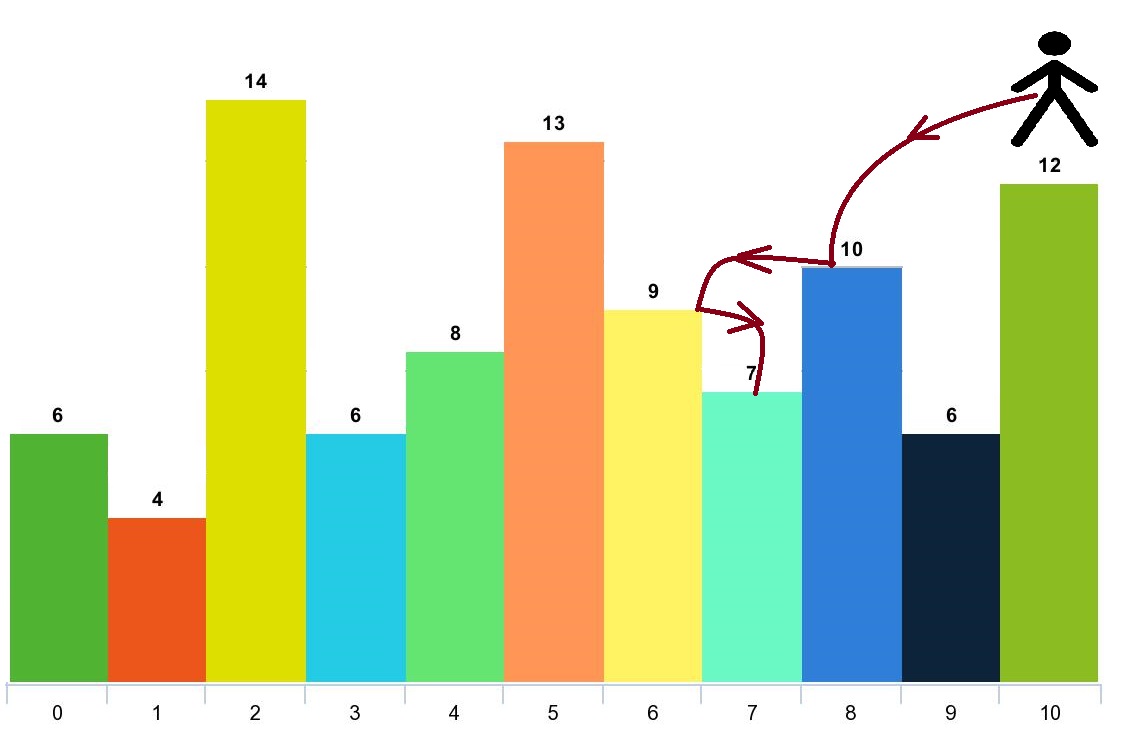
Input: arr = [6,4,14,6,8,13,9,7,10,6,12], d = 2 Output: 4 Explanation: You can start at index 10. You can jump 10 --> 8 --> 6 --> 7 as shown. Note that if you start at index 6 you can only jump to index 7. You cannot jump to index 5 because 13 > 9. You cannot jump to index 4 because index 5 is between index 4 and 6 and 13 > 9. Similarly You cannot jump from index 3 to index 2 or index 1.
Example 2:
1 2 3
Input: arr = [3,3,3,3,3], d = 3 Output: 1 Explanation: You can start at any index. You always cannot jump to any index.
Example 3:
1 2 3
Input: arr = [7,6,5,4,3,2,1], d = 1 Output: 7 Explanation: Start at index 0. You can visit all the indicies.
Constraints:
1 <= arr.length <= 1000
1 <= arr[i] <= 105
1 <= d <= arr.length
给你一个整数数组 arr 和一个整数 d 。每一步你可以从下标 i 跳到:
i + x ,其中 i + x < arr.length 且 0 < x <= d 。
i - x ,其中 i - x >= 0 且 0 < x <= d 。
除此以外,你从下标 i 跳到下标 j 需要满足:arr[i] > arr[j] 且 arr[i] > arr[k] ,其中下标 k 是所有 i 到 j 之间的数字(更正式的,min(i, j) < k < max(i, j))。
classSolution { public: vector<vector<int>> g; vector<int> dp; intdfs(int u){ if (dp[u] != -1) return dp[u]; dp[u] = 0; for (int v : g[u]) { int dist = dfs(v); // f[v] dp[u] = max(dp[u], dist); // 取最大的f[v] } dp[u] ++; // 这个++表示u到v的这条边 return dp[u]; } intmaxJumps(vector<int>& arr, int d){ int n = arr.size(); g.assign(n, vector<int>()); for (int i = 0; i < n; i ++) { // 在两个方向上,构图 for (int j = 1; j <= d && i - j >= 0 && arr[i-j] < arr[i]; j ++) // 最远不能超过d,高度小过a[i],不能跑出去边界 g[i].push_back(i - j); for (int j = 1; j <= d && i + j < n && arr[i+j] < arr[i]; j ++) // 最远不能超过d,高度小过a[i],不能跑出去边界 g[i].push_back(i + j); } dp.assign(n, -1); // 从一个点出发能走的最长路径 for (int i = 0; i < n; i ++) dfs(i);
int res = -1; for (int i = 0; i < n; i ++) res = max(res, dp[i]); return res; } };
Leetcode1346. Check If N and Its Double Exist
Given an array arr of integers, check if there exists two integers N and M such that N is the double of M ( i.e. N = 2 * M).
More formally check if there exists two indices i and j such that :
i != j
0 <= i, j < arr.length
arr[i] == 2 * arr[j]
Example 1:
1 2 3
Input: arr = [10,2,5,3] Output: true Explanation: N = 10 is the double of M = 5,that is, 10 = 2 * 5.
Example 2:
1 2 3
Input: arr = [7,1,14,11] Output: true Explanation: N = 14 is the double of M = 7,that is, 14 = 2 * 7.
Example 3:
1 2 3
Input: arr = [3,1,7,11] Output: false Explanation: In this case does not exist N and M, such that N = 2 * M.
注意0的问题,只有有两个0的时候返回true
1 2 3 4 5 6 7 8 9 10 11 12 13
classSolution { public: boolcheckIfExist(vector<int>& arr){ map<int, int> mp; for(int i = 0; i < arr.size(); i ++) mp[arr[i]] ++; for(int i = 0; i < arr.size(); i ++) { if(mp[arr[i]*2] && arr[i] != 0 || arr[i] == 0 && mp[arr[i]] > 1 ) returntrue; } returnfalse; } };
Leetcode1349. Maximum Students Taking Exam
Given a m * n matrix seats that represent seats distributions in a classroom. If a seat is broken, it is denoted by ‘#’ character otherwise it is denoted by a ‘.’ character.
Students can see the answers of those sitting next to the left, right, upper left and upper right, but he cannot see the answers of the student sitting directly in front or behind him. Return the maximum number of students that can take the exam together without any cheating being possible..
Students must be placed in seats in good condition.
Example 1:
1 2 3 4 5
Input: seats = [["#",".","#","#",".","#"], [".","#","#","#","#","."], ["#",".","#","#",".","#"]] Output: 4 Explanation: Teacher can place 4 students in available seats so they don't cheat on the exam.
Example 2:
1 2 3 4 5 6 7
Input: seats = [[".","#"], ["#","#"], ["#","."], ["#","#"], [".","#"]] Output: 3 Explanation: Place all students in available seats.
Example 3:
1 2 3 4 5 6 7
Input: seats = [["#",".",".",".","#"], [".","#",".","#","."], [".",".","#",".","."], [".","#",".","#","."], ["#",".",".",".","#"]] Output: 10 Explanation: Place students in available seats in column 1, 3 and 5.
classSolution { public: boolcheck2(int s, int ss, int m){ for (int k = 0; k < m; k ++) { int b = (s >> k) & 1; if (!b) continue; int bss0 = 0, bss2 = 0; if (k) bss0 = (ss >> (k-1)) & 1; if (k != m-1) bss2 = (ss >> (k+1)) & 1; if (bss0 || bss2) returnfalse; } returntrue; } boolcheck(int s, const vector<char>& line, int m){ int preb = 0; for (int k = 0; k < m; k ++) { int b = (s >> k) & 1; if (b && line[k] == '#') returnfalse; if (preb && b) returnfalse; preb = b; } returntrue; } intmaxStudents(vector<vector<char>>& seats){ int n = seats.size(), m = seats[0].size(); int maxseats = 1 << m; vector<int> y(maxseats, 0); vector<int> x(maxseats, 0); vector<bool> oky(maxseats, true); vector<bool> okx(maxseats, true); for (int i = 0; i < n; i ++) { x.assign(maxseats, 0); okx.assign(maxseats, false); for (int s = 0; s < maxseats; s ++) { okx[s] = check(s, seats[i], m); if (!okx[s]) continue; int cnt = 0; for (int k = 0; k < m; k ++) cnt += ( s >> k) & 1; for (int ss = 0; ss < maxseats; ss ++) if (oky[ss]) { if (!check2(s, ss, m)) continue; x[s] = max(x[s], y[ss] + cnt); } } swap(x, y); swap(okx, oky); } int maxv = 0; for (int v : y) maxv = max(maxv, v); return maxv; } };
Leetcode1351. Count Negative Numbers in a Sorted Matrix
Given a m * n matrix grid which is sorted in non-increasing order both row-wise and column-wise. Return the number of negative numbers in grid.
Example 1:
1 2 3
Input: grid = [[4,3,2,-1],[3,2,1,-1],[1,1,-1,-2],[-1,-1,-2,-3]] Output: 8 Explanation: There are 8 negatives number in the matrix.
统计一个矩阵中有多少个负数?有毛病,这么简单。
1 2 3 4 5 6 7 8 9 10 11
classSolution { public: intcountNegatives(vector<vector<int>>& grid){ int res = 0; for(int i = 0; i < grid.size(); i ++) for(int j = 0; j < grid[0].size(); j ++) if(grid[i][j] < 0) res ++; return res; } };
Leetcode1356. Sort Integers by The Number of 1 Bits
Given an integer array arr. You have to sort the integers in the array in ascending order by the number of 1’s in their binary representation and in case of two or more integers have the same number of 1’s you have to sort them in ascending order.
Return the sorted array.
Example 1:
1 2 3 4 5 6 7
Input: arr = [0,1,2,3,4,5,6,7,8] Output: [0,1,2,4,8,3,5,6,7] Explantion: [0] is the only integer with 0 bits. [1,2,4,8] all have 1 bit. [3,5,6] have 2 bits. [7] has 3 bits. The sorted array by bits is [0,1,2,4,8,3,5,6,7]
Example 2:
1 2 3
Input: arr = [1024,512,256,128,64,32,16,8,4,2,1] Output: [1,2,4,8,16,32,64,128,256,512,1024] Explantion: All integers have 1 bit in the binary representation, you should just sort them in ascending order.
classSolution { public: staticintbitnum(int a){ int res = 0; while(a) { res += a & 1; a = a >> 1; } return res; } staticboolcmp(int a, int b){ if(bitnum(a) < bitnum(b)) returntrue; elseif(bitnum(a) == bitnum(b)) return a < b; else returnfalse; } vector<int> sortByBits(vector<int>& arr){ sort(arr.begin(), arr.end(), cmp); return arr; } };
Leetcode1360. Number of Days Between Two Dates
Write a program to count the number of days between two dates. The two dates are given as strings, their format is YYYY-MM-DD as shown in the examples.
Leetcode1365. How Many Numbers Are Smaller Than the Current Number
Given the array nums, for each nums[i] find out how many numbers in the array are smaller than it. That is, for each nums[i] you have to count the number of valid j’s such that j != i and nums[j] < nums[i].
Return the answer in an array.
Example 1:
1 2 3 4 5 6 7 8
Input: nums = [8,1,2,2,3] Output: [4,0,1,1,3] Explanation: For nums[0]=8 there exist four smaller numbers than it (1, 2, 2 and 3). For nums[1]=1 does not exist any smaller number than it. For nums[2]=2 there exist one smaller number than it (1). For nums[3]=2 there exist one smaller number than it (1). For nums[4]=3 there exist three smaller numbers than it (1, 2 and 2).
classSolution { public: vector<int> smallerNumbersThanCurrent(vector<int>& nums){ vector<int> res; map<int, int> mp; for(int i = 0; i < nums.size(); i ++) { mp[nums[i]] ++; } int presum = 0; for(auto a = mp.begin(); a != mp.end(); a ++) { int sec = a->second; mp[a->first] = presum; presum = presum + sec; } for(int i = 0; i < nums.size(); i ++){ res.push_back(mp[nums[i]]); } return res; } };
Leetcode1370. Increasing Decreasing String
Given a string s. You should re-order the string using the following algorithm:
Pick the smallest character from s and append it to the result.
Pick the smallest character from s which is greater than the last appended character to the result and append it.
Repeat step 2 until you cannot pick more characters.
Pick the largest character from s and append it to the result.
Pick the largest character from s which is smaller than the last appended character to the result and append it.
Repeat step 5 until you cannot pick more characters.
Repeat the steps from 1 to 6 until you pick all characters from s.
In each step, If the smallest or the largest character appears more than once you can choose any occurrence and append it to the result.
Return the result string after sorting s with this algorithm.
Example 1:
1 2 3 4 5 6 7
Input: s = "aaaabbbbcccc" Output: "abccbaabccba" Explanation: After steps 1, 2 and 3 of the first iteration, result = "abc" After steps 4, 5 and 6 of the first iteration, result = "abccba" First iteration is done. Now s = "aabbcc" and we go back to step 1 After steps 1, 2 and 3 of the second iteration, result = "abccbaabc" After steps 4, 5 and 6 of the second iteration, result = "abccbaabccba"
classSolution { public: string sortString(string s){ string res; vector<int> ma(26, 0); int i = 0, len = s.length(); for(int i = 0; i < len; i ++) ma[s[i] - 'a'] ++; int count = 0; while(count < len) { for(int i = 0; i < 26; i ++) if(ma[i]) { res += ('a' + i); ma[i] --; count ++; } for(int i = 25; i >= 0; i --) if(ma[i]) { res += ('a' + i); ma[i] --; count ++; } } return res; } };
Leetcode1374. Generate a String With Characters That Have Odd Counts
Given an integer n, return a string with n characters such that each character in such string occurs an odd number of times. The returned string must contain only lowercase English letters. If there are multiples valid strings, return any of them.
Example 1:
1 2 3
Input: n = 4 Output: "pppz" Explanation: "pppz" is a valid string since the character 'p' occurs three times and the character 'z' occurs once. Note that there are many other valid strings such as "ohhh" and "love".
Example 2:
1 2 3
Input: n = 2 Output: "xy" Explanation: "xy" is a valid string since the characters 'x' and 'y' occur once. Note that there are many other valid strings such as "ag" and "ur".
返回一个字符串,每个字母都只出现过奇数次。神经病题,要处理奇数和偶数的不同情况。
1 2 3 4 5 6 7 8 9 10 11 12 13 14 15 16
classSolution { public: string generateTheString(int n){ string res; if(n % 2 == 0) { for(int i = 0; i < n-1; i ++) res += 'a'; res += 'b'; } if(n % 2 == 1) { for(int i = 0; i < n; i ++) res += 'a'; } return res; } };
Leetcode1380. Lucky Numbers in a Matrix
Given a m * n matrix of distinct numbers, return all lucky numbers in the matrix in any order. A lucky number is an element of the matrix such that it is the minimum element in its row and maximum in its column.
Example 1:
1 2 3
Input: matrix = [[3,7,8],[9,11,13],[15,16,17]] Output: [15] Explanation: 15 is the only lucky number since it is the minimum in its row and the maximum in its column
Example 2:
1 2 3
Input: matrix = [[1,10,4,2],[9,3,8,7],[15,16,17,12]] Output: [12] Explanation: 12 is the only lucky number since it is the minimum in its row and the maximum in its column.
classSolution { public: vector<int> luckyNumbers(vector<vector<int>>& matrix){ vector<int> res; int row = matrix.size(), col = matrix[0].size(); for(int i = 0; i < row; i ++) { int j = 0, minn = 999999, minn_j = -1; for(; j < col; j ++) { if(minn > matrix[i][j]) { minn = matrix[i][j]; minn_j = j; } } int ii; for(ii = 0; ii < row; ii ++) if(matrix[ii][minn_j] > minn) break; if(ii == row) res.push_back(minn); } return res; } };
Leetcode1385. Find the Distance Value Between Two Arrays
Given two integer arrays arr1 and arr2, and the integer d, return the distance value between the two arrays. The distance value is defined as the number of elements arr1[i] such that there is not any element arr2[j] where |arr1[i]-arr2[j]| <= d.
Example 1:
1 2 3 4 5 6 7 8 9 10 11 12 13 14 15 16 17 18
Input: arr1 = [4,5,8], arr2 = [10,9,1,8], d = 2 Output: 2 Explanation: For arr1[0]=4 we have: |4-10|=6 > d=2 |4-9|=5 > d=2 |4-1|=3 > d=2 |4-8|=4 > d=2 For arr1[1]=5 we have: |5-10|=5 > d=2 |5-9|=4 > d=2 |5-1|=4 > d=2 |5-8|=3 > d=2 For arr1[2]=8 we have: |8-10|=2 <= d=2 |8-9|=1 <= d=2 |8-1|=7 > d=2 |8-8|=0 <= d=2
计算一行中没有差的绝对值大于d的行数。「距离值」 定义为符合此描述的元素数目:对于元素 arr1[i] ,不存在任何元素 arr2[j] 满足 |arr1[i]-arr2[j]| <= d 。
1 2 3 4 5 6 7 8 9 10 11 12 13 14 15 16
classSolution { public: intfindTheDistanceValue(vector<int>& arr1, vector<int>& arr2, int d){ int res = 0; for(int i = 0; i < arr1.size(); i ++) { int j; for(j = 0; j < arr2.size(); j ++) { if(abs(arr1[i] - arr2[j]) <= d) break; } if(j == arr2.size()) res ++; } return res; } };
Leetcode1389. Create Target Array in the Given Order
Given two arrays of integers nums and index. Your task is to create target array under the following rules:
Initially target array is empty.
From left to right read nums[i] and index[i], insert at index index[i] the value nums[i] in target array.
Repeat the previous step until there are no elements to read in nums and index.
Return the target array.
It is guaranteed that the insertion operations will be valid.
voidmove(vector<int>& nums, int i){ int ii; for(ii = i + 1; ii < nums.size() && nums[ii] != -1; ii ++); for(int k = ii; k > i; k --) { nums[k] = nums[k-1]; } } vector<int> createTargetArray(vector<int>& nums, vector<int>& index){ vector<int> res(nums.size(), -1); for(int i = 0; i < nums.size(); i ++) { if(res[index[i]] == -1) res[index[i]] = nums[i]; else { move(res, index[i]); res[index[i]] = nums[i]; } } return res; } };
Leetcode1394. Find Lucky Integer in an Array
Given an array of integers arr, a lucky integer is an integer which has a frequency in the array equal to its value. Return a lucky integer in the array. If there are multiple lucky integers return the largest of them. If there is no lucky integer return -1.
Example 1:
1
2
3
Input: arr = [2,2,3,4] Output: 2 Explanation: The only lucky number in the array is 2 because frequency[2] == 2.
Example 2:
1
2
3
Input: arr = [1,2,2,3,3,3] Output: 3 Explanation: 1, 2 and 3 are all lucky numbers, return the largest of them.
classSolution { public: intfindLucky(vector<int>& arr){ sort(arr.begin(), arr.end()); int prev = arr[0], count = 1, res = -1; for(int i = 1; i < arr.size(); i ++) { if(prev != arr[i]) { if(count == prev) res = prev; prev = arr[i]; count = 1; } else { count ++; } } if(count == prev) res = prev; return res; } };
Leetcode1399. Count Largest Group
Given an integer n. Each number from 1 to n is grouped according to the sum of its digits. Return how many groups have the largest size.
Example 1:
1 2 3 4
Input: n = 13
Output: 4
Explanation: There are 9 groups in total, they are grouped according sum of its digits of numbers from 1 to 13:
[1,10], [2,11], [3,12], [4,13], [5], [6], [7], [8], [9]. There are 4 groups with largest size.